
1. Why the “15-Minute City” Failed
The term “15-Minute City” was designed by academics for academics. When it hit the real world, it collided with the post-COVID trauma of the public.
The Narrative Failure: It sounds like a prison sentence. “You can only travel 15 minutes.” It triggers the fear of Lockdown.
The Conspiracy: It became synonymous with “Climate Lockdowns,” “Zoning Walls,” and top-down control.
The Optics: It frames the city as a constraint (Time Limit) rather than an asset (Convenience).
To a Libertarian or a working-class commuter, a “15-Minute City” sounds like a bureaucrat standing with a stopwatch, telling you where you can’t go.
2. THE CURE: “The Village of Options”
We are pivoting the core value proposition from Efficiency to Sovereignty.
The Core Concept:
We are not restricting your movement; we are giving you the option to not move.
We are not taking away your car; we are giving you the freedom to not need one.
The Rebrand in 3 Parts:
A. From “Restriction” to “The Ultimate Luxury”
Old Brand: “You must stay in your zone.” (Socialist/Authoritarian).
New Brand: “The Village of Options.” (Capitalist/Libertarian).
The Pitch: Time is the ultimate asset. The rich have always lived in “Villages of Options” (Manhattan, Paris, Aspen) where they can walk to a cafe, a doctor, and a park.
The Promise: We are democratizing the lifestyle of the wealthy. We are giving you the option to walk to the grocery store so you don’t have to burn gas. It is a “Freedom Dividend” of time.
B. From “Zoning” to “Legalizing the Neighborhood”
Old Brand: “We will re-zone your city.” (Top-Down).
New Brand: “We will Legalize the Corner Store.” (Bottom-Up).
The Pitch: Currently, it is illegal to open a cafe in your garage. It is illegal to build a granny flat. The government is stopping you from building a village.
The Promise: We are cutting the red tape. We are allowing Micro-Enterprise in every home. We are letting the neighborhood build itself.
C. From “Traffic Control” to “Local Velocity”
Old Brand: “Anti-Car Measures.” (Punitive).
New Brand: “Local Velocity.” (Economic).
The Pitch: Why should your money leak out to a gas station or a big-box store 20 minutes away?
The Promise: In a Village of Options, your dollar stays local. You pay the local baker, the local mechanic, the local tutor. It is an economic engine, not a traffic plan.
3. THE VISUAL LANGUAGE
We stop using maps that look like “Zones” or “Districts” (which look like targets).
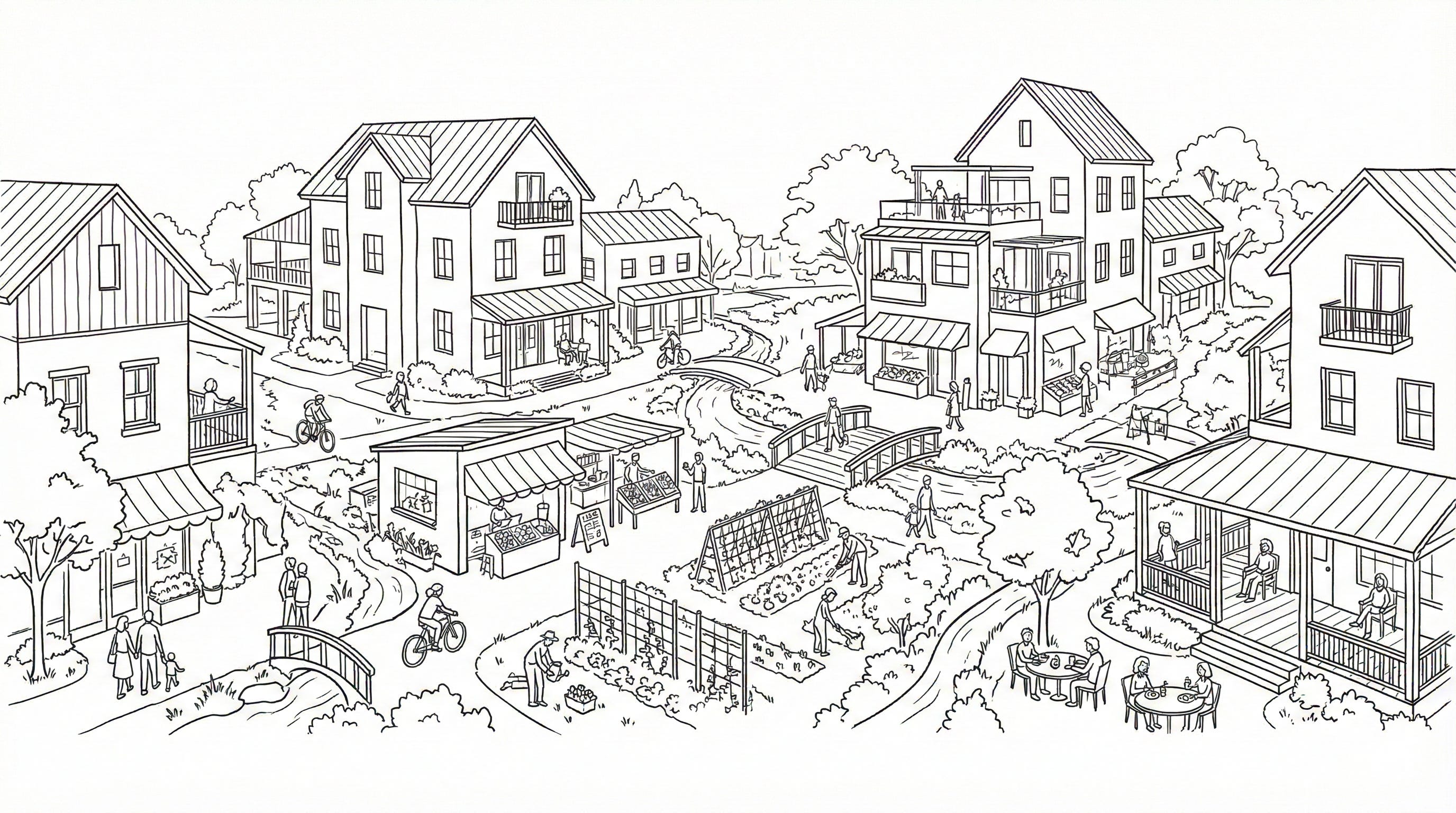
We start using imagery of “The Porch,” “The Micro-Main Street,” and “The Garage Startup.”
Visual A: A map showing “15-Minute Radius” (Bad: Looks like a geofence).
Visual B: A rendering of a “Village Node” showing a kid walking to school and a dad working from a cafe. (Good: Looks like freedom).
Conclusion: The Pivot
The “15-Minute City” was about Urban Planning.
The “Village of Options” is about Civil Rights.
The Right to Walk.
The Right to Trade.
The Right to Rest.
We stop arguing about traffic patterns and start arguing about Liberty.
-Diego Rodriguez Renovales